

HOW SUPPORT COORDINATORS CAN DETERMINE IF UPHOLSTERY CLEANING IS “REASONABLE AND NECESSARY” UNDER NDIS
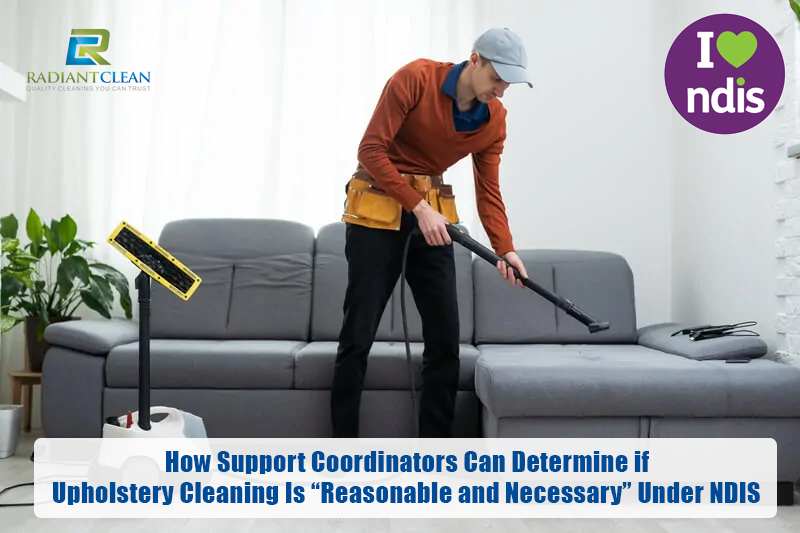
Under the National Disability Insurance Scheme (NDIS), every funded support must meet the “reasonable and necessary” criteria. While upholstery cleaning is often seen as general household maintenance, there are situations where it can be funded if it directly relates to a participant’s disability.
Support Coordinators play an important role in assessing whether professional upholstery cleaning aligns with a participant’s health, safety, and plan goals.
Understanding the Criteria
To begin with, for a support to be considered reasonable and necessary, it must:
-
Be related to the participant’s disability
-
Help the participant pursue their goals
-
Represent value for money
-
Be effective and beneficial
-
Not be more appropriately funded through another system
Ultimately, the key question is: Would this support still be required if the participant did not have their disability? If the answer is no, there may be a strong case for funding.
When Upholstery Cleaning May Qualify
In certain situations, upholstery cleaning can meet the criteria, especially when it is clearly linked to disability-related needs.
Disability-Related Health Needs
For example, participants with respiratory conditions, compromised immunity, or severe allergies may require a consistently hygienic living environment. Dust mites, bacteria, and mould trapped in lounges and chairs can exacerbate symptoms. As a result, regular professional cleaning may be necessary to reduce health risks. Importantly, supporting evidence from a GP or occupational therapist can significantly strengthen the funding justification.
Psychosocial or Functional Limitations
Similarly, participants with psychosocial disabilities or limited functional capacity may experience difficulty maintaining adequate household hygiene. Over time, heavily soiled upholstery can create health hazards or safeguarding concerns. In such cases, professional cleaning may be appropriately funded under Core Supports.
SIL and SDA Settings
Furthermore, in Supported Independent Living (SIL) or Specialist Disability Accommodation (SDA) settings, maintaining safe and hygienic shared spaces is particularly important. Not only does regular upholstery cleaning help reduce infection risks, but it also protects property and supports tenancy stability.
Steps for Support Coordinators
When assessing eligibility, Support Coordinators should:
-
Review the participant’s funding categories
-
Gather supporting documentation (such as reports, risk assessments, or incident records)
-
Demonstrate value for money
-
Clearly document how the service supports the participant’s goals and wellbeing
By following these steps, coordinators can build a well-supported justification.
Final Thoughts
Upholstery cleaning is not automatically funded under the NDIS. Nevertheless, when it is directly connected to disability-related health, safety, or functional needs, it can satisfy the reasonable and necessary criteria. Therefore, with proper assessment, strong documentation, and clear alignment to plan goals, Support Coordinators can confidently advocate for participants while remaining fully compliant.
If you need any assistance, please don’t hesitate to contact our Radiant Clean Experts:
📞 Call us: +61 3 9367 7198
🌐 Book online: https://radiantclean.com.au/services/upholstery-cleaning/
▶️ Watch video: https://www.youtube.com/@radiantcleanndis

